
CNC strength,
heading-line economics.
We take components you thought had to be fully machined and form them on high-speed headers instead — same function, stronger grain flow, and a unit cost that changes how you price the assembly.
Cold heading + minimal machining
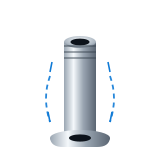
Our signature combination — cold heading plus just enough secondary machining — turns "over-engineered" CNC parts into strong, low-cost, mass-producible components. The flagship is the 6061 aluminum lifting sleeve for EV battery packs: precision threads, continuous grain flow, and a 60% cost reduction over full CNC.
- Up to 98% material utilization — near-zero waste
- Unbroken grain flow = superior fatigue & fracture resistance
- Unit cost cut ~60%, output up to 5× vs. pure CNC
- Custom studs, pins, plungers, spacers & assemblies
What we make beyond standard screws
| Component | Function | Typical spec |
|---|---|---|
| 6061 lifting sleeve | Battery pack lifting, positioning & securing | Flanged hollow sleeve, precision top threads |
| Threaded studs & standoffs | Spacing & mounting | M3 – M12, custom length |
| Spring-loaded pins / plungers | Detent, retention, positioning | Ball & spring assemblies, steel or stainless |
| Combined male-female fasteners | Two-in-one joining | Patented inner-outer thread parts |
Materials span aluminum 6061 and other light alloys for weight-critical components, plus carbon, alloy and stainless steels for strength-critical parts. Finishes include anodizing, chromate, plating and pre-applied sealant or adhesive.
High-volume parts priced like standard fasteners
EV & PHEV battery lines
The 6061 lifting sleeve gives pack assemblers a precise, reusable thread point for lifting and securing modules — at a cost that scales with vehicle production.
New-energy vehicle structure
Light-alloy studs, standoffs and hybrid fasteners that cut mass while keeping galvanic compatibility with the surrounding structure.
Anything over-priced by CNC
If a machined component runs into the tens of thousands of pieces a year, we will almost always find a heading-first way to make it cheaper.
Send us the drawing — even a rough one. We'll return a process proposal: headed, machined, or hybrid, with a target unit cost and tooling plan.
Send your drawingYou may also need
Aluminum alloy bolts
ZT68 7-series bolts with steel-level strength at ~65% lower weight — the same light-alloy logic, applied to threaded joints.
View familyThread inserts & bushings
Wear-resistant thread points for the soft-metal housings these light components bolt into.
View familyRivet nuts & rivet bolts
One-sided threaded points when you need a new thread on thin sheet or closed-section profiles.
View familyCustom-parts questions we hear most
Whenever the shape can be formed rather than cut and volumes justify tooling. Cold heading uses only a few percent of the material a CNC part wastes, runs 5× faster, and leaves grain flow unbroken — stronger around heads and threads. Below roughly 10,000–20,000 pieces a year, machining can still win on tooling cost; above it, heading almost always wins.
Yes — that's what the "plus minimal secondary machining" step is for. Forming gets you the near-net shape and the grain flow; a short CNC or thread-rolling pass holds the critical diameters, threads and faces. You keep most of the cost saving with none of the tolerance compromise.
A drawing (even a marked-up photo), the material and finish if specified, and an annual volume. We use that to pick the process route and return a feasibility note with an estimated unit cost — usually within a few working days.
Paying CNC prices for a part that could be headed?
Send us the print and we'll engineer the process — cold-headed, machined, or a hybrid of both — with a target unit cost attached.