
High-strength aluminum bolts,
without the weight.
Cold-headed aluminum alloy bolts — led by our flagship ZT68 series — deliver steel-level strength at up to 65% lower weight, with corrosion and thermal behavior matched to light-alloy housings.
Why switch a steel joint to ZT68?
Because the electrochemical potential of our aluminum alloys closely matches magnesium and aluminum substrates, ZT68 bolts eliminate galvanic corrosion without washers or isolation coatings. Their matched coefficient of thermal expansion keeps joints tight as housings heat and cool, and the integral flange design merges bolt and washer into one part.
- ZT68 (7xxx): tensile ≥ 615 MPa · yield ≥ 490 MPa · elongation ≥ 8%
- Stable at 150 °C / 12 h endurance at ≥ 600 MPa
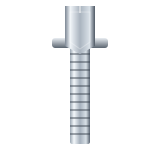
- Integral flange — bolt + washer in one, fewer parts, less inventory
- Short 1.3–1.5d engagement enables thinner, lighter housings
- Cold-headed for continuous grain flow and near-zero scrap
Alloys, surfaces & verified performance
Numbers below are from batch-verified testing on M8×35 specimens (5 mm/min crosshead, uniform standard) — representative of production, not best-case lab results.
Material & surface options
| Alloy | Position | Typical use |
|---|---|---|
| ZT68 (7xxx) | Ultra-high strength | Transmissions, Mg/Al housings, structural EV joints |
| 6056 (6xxx) | High strength | Grade 8.8 / 10.9-equivalent general light-alloy fastening |
| Anodized finish | Protection + hardness | Passes 60-day neutral salt spray; hard, wear-resistant |
| Lubricant coating | Assembly control | Total friction coefficient 0.09–0.15 for torque-angle control |
Size range & performance
| Parameter | Typical value | Test |
|---|---|---|
| Thread sizes | M5 – M12; M6×1.0 / M8×1.25 common | Custom per drawing |
| Tensile strength Rm | ≥ 615 MPa (avg. 629) | Tensile test |
| Yield strength Rp0.2 | ≥ 490 MPa (avg. 510) | Tensile test |
| Elongation Af | ≥ 8% | 2d gauge |
| Failure torque | > 25 N·m (M8×35) | Torque to failure |
| Hardness | HV 202 – 209, uniform | Vickers |
| Thermal endurance | 150 °C / 12 h @ ≥ 600 MPa | Thermal exposure |
Weight-critical, corrosion-critical, heat-exposed
- Electric & hybrid drivetrains — transmission and e-motor housings in Mg or Al die casting
- Battery trays, converters and structural light-alloy assemblies
- Two-wheelers, motorcycles and lightweight vehicle programs
- Low-altitude platforms and any weight-critical structure
Each gram you remove from a rotating or sprung assembly pays twice — once in performance, once in energy. Our engineers can model the weight and cost swap for your specific joint.
Request a weight-save studySee them in action
Explore how aluminum bolts and our other fastening families are applied across new-energy vehicles, robotics, servers and more.
← Back to all product familiesYou may also need
6061 lifting sleeves
The EV battery lifting sleeve — cold-headed 6061 aluminum replacing full CNC at ~60% lower cost.
View familyRivet nuts & rivet bolts
Threaded points installed from one side in thin sheet — the companion solution for battery enclosures.
View familyThread inserts & bushings
Repair or strengthen threads in the same soft aluminum and magnesium housings.
View familyAluminum bolt questions we hear most
ZT68 replaces 8.8–10.9-class steel in most light-alloy joints at a fraction of the weight, and it removes the galvanic-corrosion and thermal-expansion mismatch that steel introduces against aluminum and magnesium. Joint design differs — shorter engagement (1.3–1.5d) and controlled friction — which is exactly what our DFM engineers help you set up.
In the majority of aluminum-on-aluminum or aluminum-on-magnesium joints, no. Because the fastener shares the substrate's electrochemical potential, the washer-and-coating stack typically disappears — one fewer part to buy, stock and assemble.
Standard threads run M5–M12 (M6×1.0 and M8×1.25 are the most common), with flange, hex and custom head forms. Sizes beyond the standard range are developed from your drawing — send it and we'll confirm formability in one working day.
Thinking of converting a steel joint to aluminum?
Send us the joint drawing and annual volume — we'll return a weight, cost and torque analysis on your actual application.