

The Junker Test (DIN 65151 / ISO 16130): How Vibration Resistance Is Actually Measured
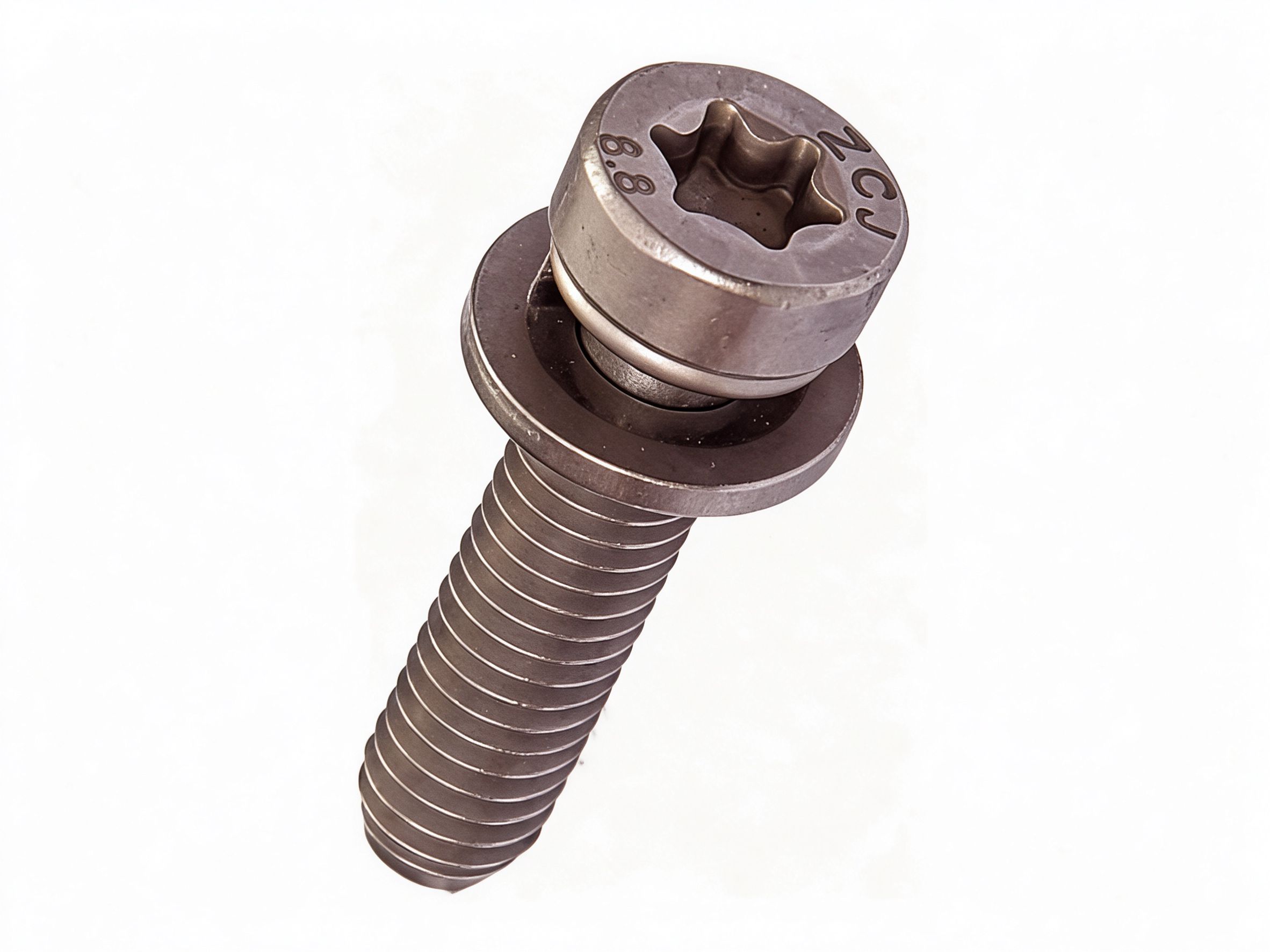
Every fastener marketing sheet claims "vibration resistant." The Junker test is how those claims are forced to prove it.
Bottom line: for most Anti-Loosening Series applications the decision comes down to load, environment and assembly method — the Anti-Loosening Series guide walks through the selection.
What the machine does
A bolted sample is clamped to a plate that oscillates transversely — sideways relative to the bolt axis — under servo control. Displacement is pushed to the slip limit while a load cell continuously records residual preload. The test runs until preload collapses or a fixed cycle count ends.
Reading the curve
The plot of preload versus cycles tells the story: an unprotected bolt loses 80% of preload within a few hundred cycles once slip begins; a good locking system retains 60–80% through the full run. Beware of reports showing only "cycles survived" without preload axis — the shape of decay matters more than the endpoint.
Using the test in procurement
- Ask for the standard cited (DIN 65151 or ISO 16130), amplitude, and clamp length — results are not comparable across setups.
- Test the real joint: coating, hole clearance and surface finish all shift the slip point.
- Require at least three samples; locking performance has statistical spread.
Topprecision validates its locking inserts and patch screws on Junker benches and supplies the raw curves with test reports, not just pass badges.
Anti-loosening methods under transverse vibration
| Method | Preload retained after 1000 cycles | Reusable | Cost |
|---|---|---|---|
| Plain nut (no lock) | <5% | Yes | Low |
| Spring lock washer | <3% (worse than plain) | Yes | Low |
| Nylon insert nut (NYLOC) | ~40% | Limited (5x) | Medium |
| All-metal prevailing torque | ~55% | Yes | Medium |
| Wedge lock washer (Nord-Lock) | ~85% | Yes | High |
| Pre-applied thread locker | >95% | Limited | Medium |
Need a vibration-proof fastener solution?
Toprecision supplies prevailing-torque lock nuts, nylon-insert nuts, wedge lock washers and pre-applied thread-locking patches for EV powertrains, rail and vibrating machinery. Send the vibration frequency and clamp load requirement — we will recommend the locking method and supply Junker test data. Request anti-loosening consult.
Reading a Junker Test Report
A Junker test report shows the remaining preload as a percentage of the initial preload over cycles. A good result is 90%+ after 10,000 cycles. Pay attention to the test conditions: vibration amplitude, frequency, and clamp length. A fastener that passes on a thick steel joint may fail on a thin aluminum one. Always request the test report for your specific application, not just a generic "pass/fail" claim.