

Torque-Tension Reference: How Much Torque for M6, M8, M10?
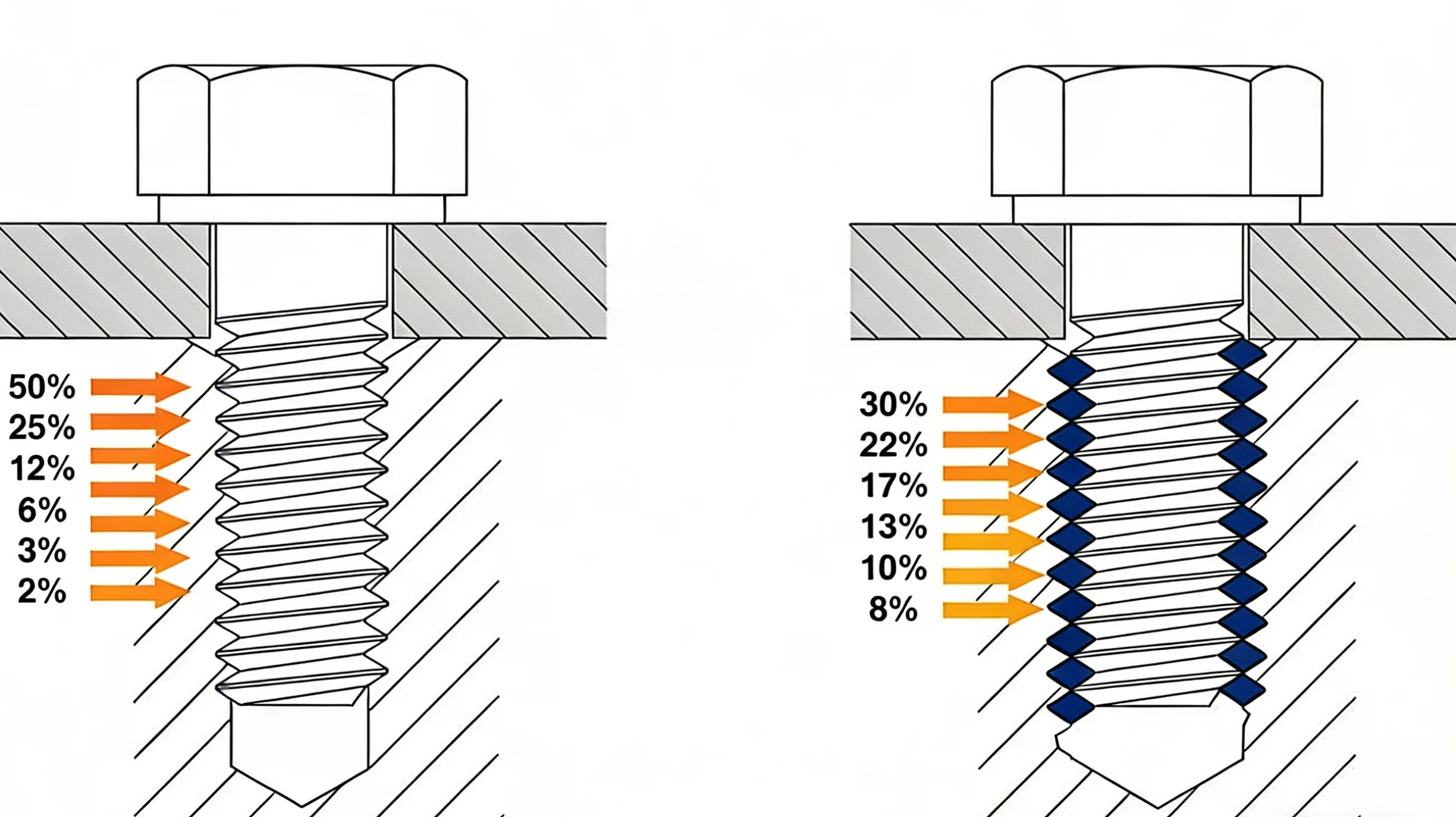
The torque wrench setting is the most-asked and most-misunderstood number in fastener assembly. A bolt tightened to the "catalog" torque may deliver only 50% of its intended preload if the threads are dry, and 90% if they are oiled. Torque is a proxy for clamp load, and the relationship between them is dominated by friction — not by the bolt's tensile strength.
The short answer: torque ≈ 0.2 × proof load × nominal diameter for dry, zinc-plated fasteners. Use 0.16–0.18 for lubricated joints and re-derive the number whenever the coating changes.
Torque reference for metric hex bolts (8.8, zinc-plated, dry)
| Size | Pitch | Stress area (mm²) | Proof load 8.8 (kN) | Torque 8.8 dry (N·m) | Torque 10.9 dry (N·m) |
|---|---|---|---|---|---|
| M5 | 0.8 | 14.2 | 8.2 | 6 | 9 |
| M6 | 1.0 | 20.1 | 11.7 | 10 | 16 |
| M8 | 1.25 | 39.7 | 23.0 | 25 | 38 |
| M10 | 1.5 | 58.0 | 33.6 | 49 | 75 |
| M12 | 1.75 | 84.3 | 48.9 | 85 | 130 |
| M16 | 2.0 | 157 | 91.1 | 210 | 320 |
The torque-tension formula
The relationship follows T = K × F × d, where T is torque, F is preload, d is nominal diameter, and K (the nut factor) captures friction. For dry zinc-plated fasteners K ≈ 0.20. For oiled or wax-lubricated fasteners K ≈ 0.14–0.16. For PTFE-coated or MoS₂-lubricated fasteners K can drop to 0.10 — meaning the same torque delivers nearly double the preload.
This is why changing the coating without changing the torque chart is the fastest way to strip threads or yield bolts. The 0.20 default assumes the exact surface finish on the catalog. Switch from bright zinc to Dacromet to LC dry film, and the torque setting must move with it.
The three torque mistakes
1. Using one torque for all surfaces. A dry M8 8.8 bolt needs ~25 N·m. An oiled M8 8.8 bolt at the same 25 N·m yields at ~40% over intended preload. Always specify the lubricant or coating on the drawing, and use the matching torque chart.
2. Torque-to-yield on production lines without angle control. Torque-only tightening scatters ±25% on dry joints. For safety-critical automotive and chassis joints, torque-plus-angle (e.g. 40 N·m + 90°) removes the friction variable and delivers consistent preload.
3. Re-torquing after relaxation. A bolt that loses 10–20% preload in the first 24 hours (embedded gasket, creeping aluminum) needs a re-torque pass, not a higher initial torque. Over-tightening to compensate crushes the gasket and stretches the bolt past yield.
Toprecision supplies fasteners with specified friction coefficients (Kl 0.09–0.15) via LC dry film, wax and MoS₂ lubricants, so production torque charts hold scatter to within ±10%. Send the joint design and production tool — we will recommend the surface finish and torque target that match your assembly process. Request a torque-chart consult with friction-coefficient test data.