

M0.6 Micro Fasteners for AI Hardware: Why a 15-Cent Screw Can Stop a 100 kW Rack
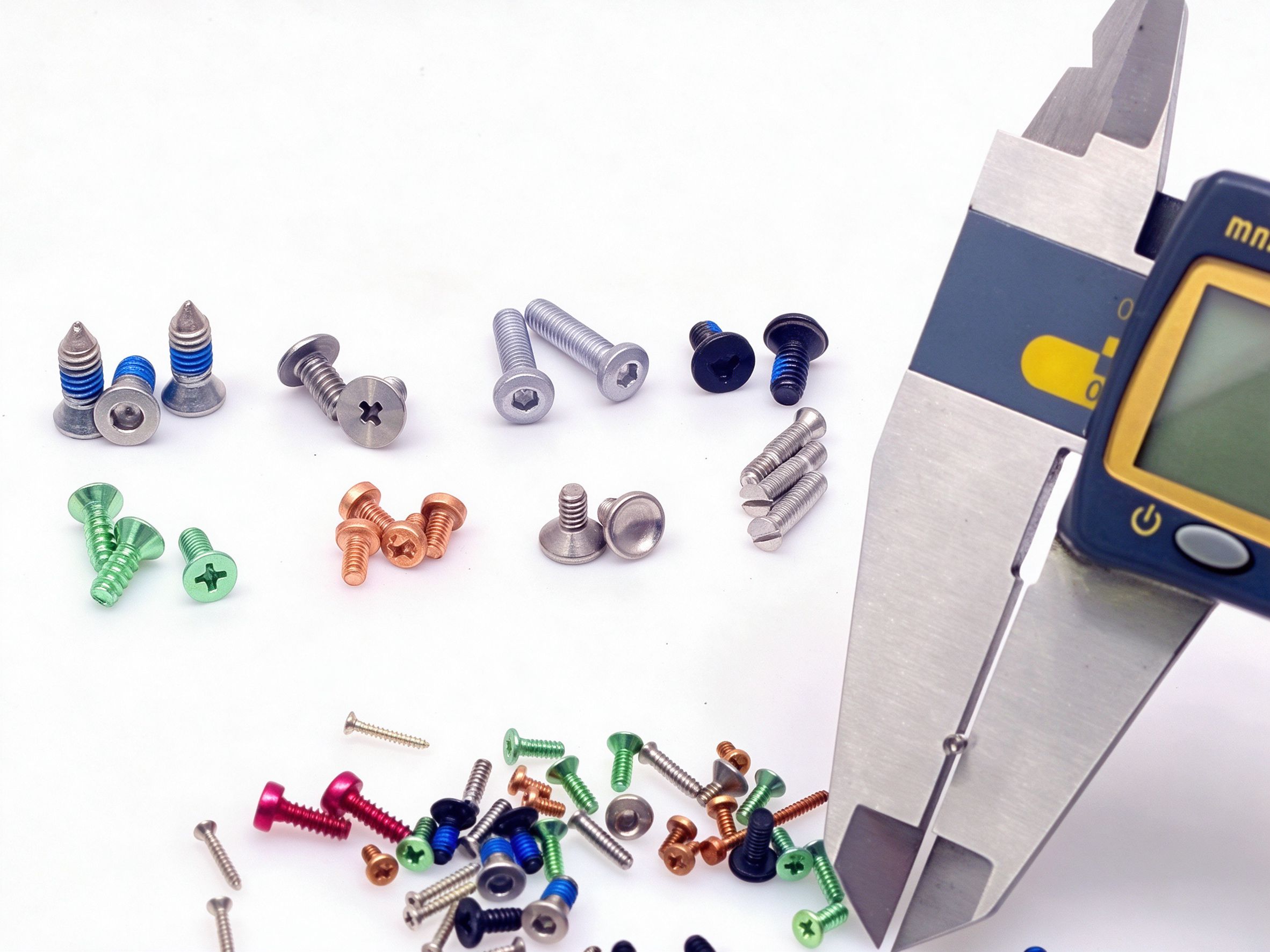
AI compute density has crossed a threshold: a single AI server rack now approaches 100 kW — six to ten times a traditional rack. High-speed optical modules move toward 800G and 1.6T, squeezing internal space to the millimeter. A humanoid robot carries hundreds of fasteners, many at the M1–M4 range at the joints. The smaller the machine, the more reliable the connection has to be — and at this scale, the fastener often fails before the chip does.
The short answer: the fastener purchase price is only ~15% of total cost. The other 85% is design, supply chain, assembly, quality and warranty — and a single mis-sized M0.6 can cost a hundred times its price in rework, line stoppage or field returns. Treating micro fasteners as a commodity screw is the most expensive mistake an AI hardware program can make.
Why M0.6 is not just a small M6
The smaller the screw, the harder it gets — non-linearly. Effective thread length on an M0.6 is barely over a millimeter, so any micro-variation in material flow, thread form or head forming is amplified at assembly into a failure. The requirements stack up fast:
- Material must be matched to the joint. Stainless, titanium, aluminum, copper alloy or engineered plastic — each chosen for strength, galvanic compatibility and the specific stress state.
- It must run on automated SMT lines. Tape-and-reel packaging, pickup geometry and coplanarity have to match high-speed placement; a screw that cannot feed cleanly does not get used, no matter how good the metallurgy.
- It must survive the environment. Vibration, thermal swing and liquid-cooling loops demand combined anti-loosening (chemical pre-coat, serrated flange) and sealing (IP68, captive) solutions, not a plain screw.
The 15/85 cost model for procurement
After years of serving premium global manufacturing customers, the pattern is consistent: the fastener itself accounts for roughly 15% of the total cost of a fastened assembly. The remaining 85% is consumed in engineering changes, line downtime from bad lots, field warranty, and supply-risk exposure when micro fasteners come only from offshore sources with long lead times.
For management, this is no longer a "buy a screw" decision — it is supply-chain risk insurance. A geopolitical disruption or a 12-week lead-time extension on a critical M0.6 is a production-line stoppage, not a purchasing inconvenience.
What Toprecision brings to micro fasteners
Toprecision has manufactured M0.6–M2 precision micro screws and nuts since the consumer-electronics miniaturization era. The company qualified into the supply chain of a global top-5 handset brand, where micro-form, consistency and automated-assembly requirements are the most demanding in the industry. That capability has migrated directly into AI hardware:
- Micro precision screws, super screws, custom SMT staking nuts and spacers for multilayer PCB-to-PCB and PCB-to-sheet-metal joints, tape-and-reel ready for high-speed SMT.
- Anti-loosening and sealing options — chemical pre-coat, serrated flange, IP68 sealing, captive/screw-retention variants — covering dry server rooms to liquid-cooled modules.
- Scale and traceability — monthly output around 500 million fasteners, 26 active patents, IATF 16949 quality system, production across Shenzhen HQ, Xiangyang automotive plant and the Indonesia overseas plant, with sales and service in Japan, the US and India.
Where these micro fasteners land in AI hardware
- AI servers and GPU boards — high-density PCB micro fasteners, super-screw mounting, SMT staking nuts.
- High-speed optical modules — precision micro connections for housings and structural parts, where consistency at sub-mm scale is decisive.
- Liquid-cooling manifolds and modules — micro joints that must hold temperature and seal under thermal cycling.
- Humanoid robots and embodied AI — maintenance-free M1–M4 micro high-strength joints at the actuators.
- Sensors, cameras and smart modules — the micro screw directly sets module yield and repairability.
For engineering and procurement teams, the practical moves are: put micro fasteners into the supply-chain strategy (evaluate by TCO, not unit price); bring the fastener supplier into joint design at the prototype stage; and audit for consistency, certification, global capacity and rapid sample turnaround — not just unit price and lead time. Toprecision delivers engineering samples in as fast as 1 day, with joint simulation and a 0-PPM quality target. Start a joint evaluation for your next AI-hardware platform.
M0.6–M1.2 Micro Screw Specifications
Micro screws below M1.5 are manufactured by Swiss-type CNC or screw-machine processes, not by standard cold heading. Head diameters are typically 1.0–2.0 mm, and slot or Torx drive profiles are cut under 10× magnification. Here are reference dimensions:
| Nominal Size | Thread Pitch | Head Diameter | Head Height | Drive Type | Tightening Torque |
|---|---|---|---|---|---|
| M0.6 × 0.15 | 0.15 mm | 1.1 mm | 0.4 mm | Slotted / Phillips 00 | 0.015 N·m |
| M0.8 × 0.2 | 0.2 mm | 1.4 mm | 0.5 mm | Phillips 00 | 0.03 N·m |
| M1.0 × 0.25 | 0.25 mm | 1.7 mm | 0.6 mm | Phillips 00 / Torx T1 | 0.06 N·m |
| M1.2 × 0.25 | 0.25 mm | 2.0 mm | 0.7 mm | Torx T2 | 0.12 N·m |